Payment · authentication · WIALOCK1 (PBKDF2 + AES-GCM, in-browser)
A note only the passphrase opens
The text is encrypted in your browser before it becomes a code. Whoever scans sees a locked card and needs the passphrase — a safe-deposit note, a recovery hint, a message for one person.
Opens the generator with this type selected. Everything happens in your browser.
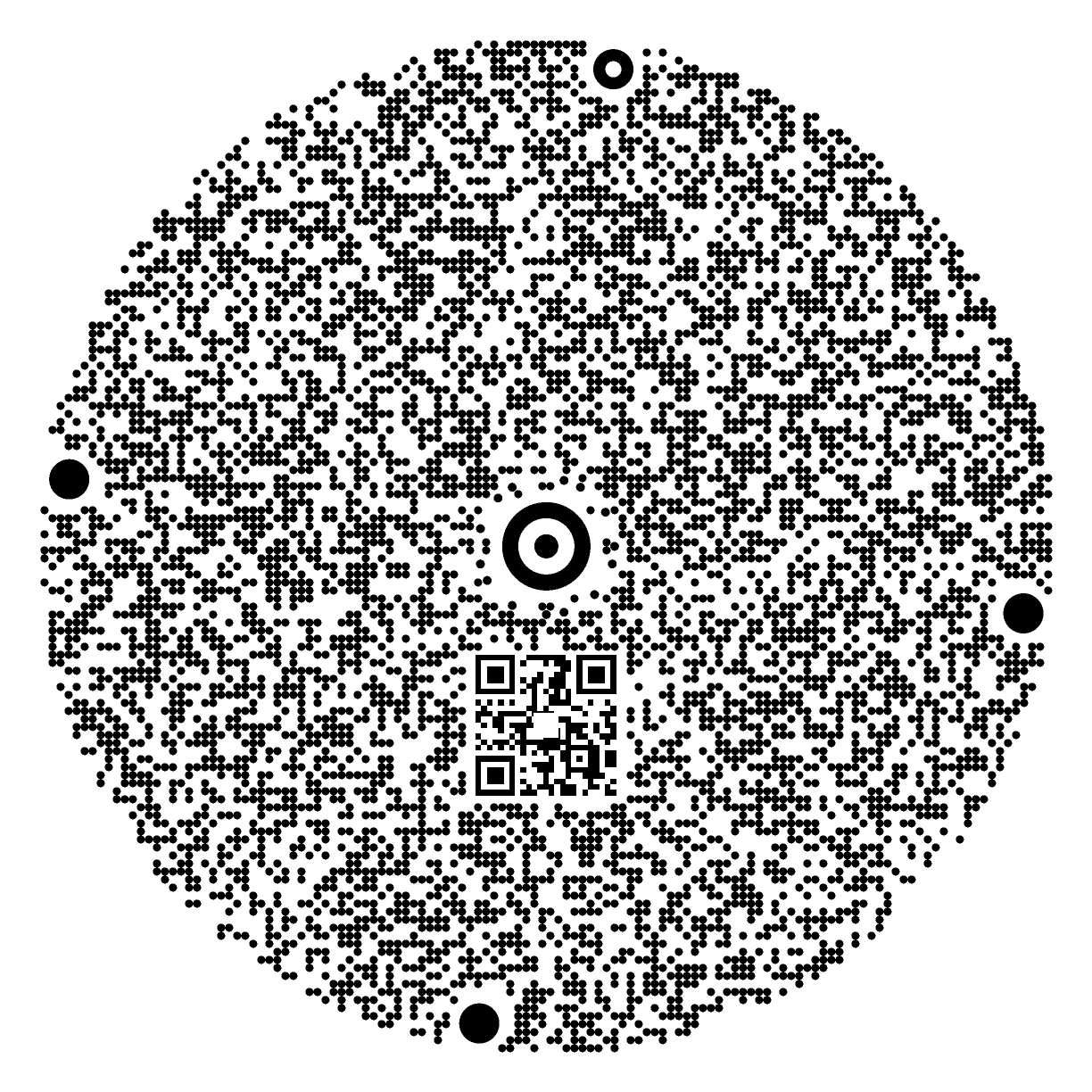
This example carries plain text rather than a real locked card payload: WIA never renders real locked card contents on public pages, because that content belongs only on a code you print yourself.
What the code carries
A WIALOCK1 record: the ciphertext, a salt and a nonce. The key is derived from your passphrase with PBKDF2 (600,000 rounds) and the text is sealed with AES-GCM — all inside the browser; the passphrase and the plain text never leave your device.
What happens when it is scanned
- The scanner reads the locked record from the code — offline.
- It shows a locked card and asks for the passphrase.
- If the passphrase is right, the text appears on the phone; if not, nothing is revealed.
Why a WIA Code for this
How much fits
Measured on the live engine (bytes of content, after error correction). The QR column is a standard QR code of the same printed size, for comparison.
| Grid | WIA Code (bytes) | Same-size QR (bytes) | With booster QR |
|---|---|---|---|
| S · 64 modules · round | 239 | 60 | — |
| M · 96 modules · round | 608 | 151 | — |
| L · 128 modules · round | 1128 | 322 | 1092 |
This page's example is 101 bytes. The booster QR is a small standard QR placed in the centre so phones without the WIA scanner still get somewhere useful — it leads to the web scanner, which then reads the full code.
Before you print it
Choose a passphrase you can remember or store separately: there is no reset. WIA does not render real locked cards on public pages; the example below is plain text.
Questions people ask
What if I forget the passphrase?
Can WIA read my note?
How strong is it?
Can I unlock it without the WIA scanner?
Why is the example on this page plain text?
Other kinds of content
WIA Code is a radial-symmetry 2D code. The content lives in the code; there is no server in between when it is scanned. Generated with the WIA Code engine · scannable · no account needed